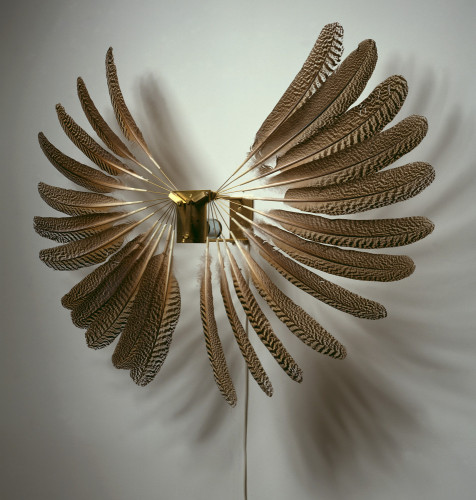
REBECCA HORN Large Feather Wheel 1997. Feathers, metal construction, motor. Courtesy of the artist.
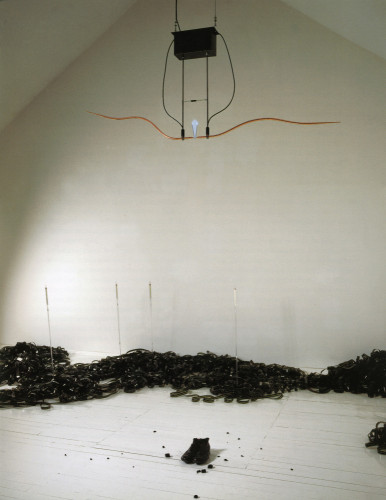
REBECCA HORN Time Goes By 1990/91. Installation. Courtesy of the artist.
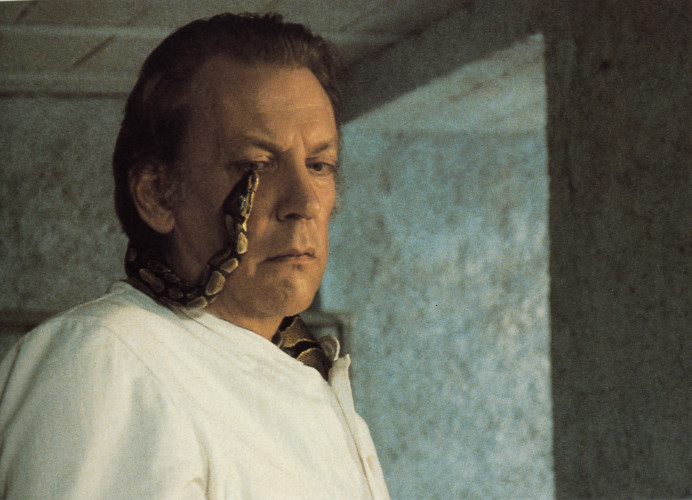
REBECCA HORN Buster's Bedroom 1990 (film still). VG Bild-Kunst, Bonn. Courtesy Institut fur Auslandsbeziehungen e V.,Stuttgart.
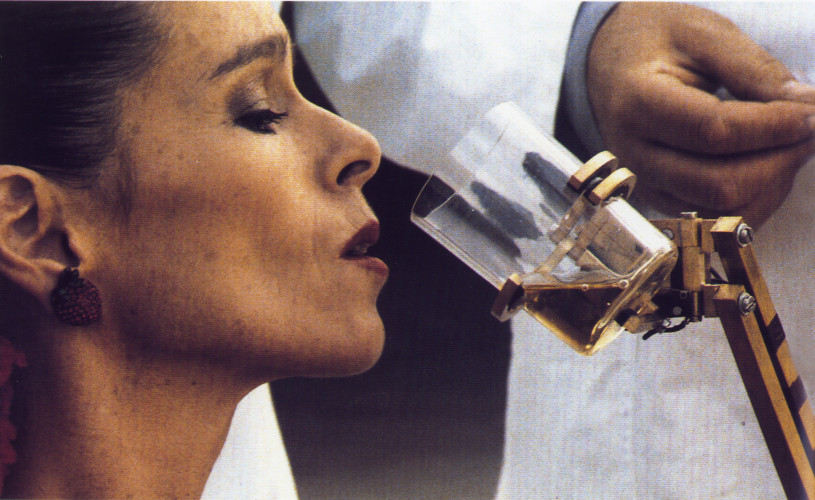
REBECCA HORN Buster's Bedroom 1990 (film still). VG Bild-Kunst, Bonn. Courtesy Institut fur Auslandsbeziehungen e V.,Stuttgart.
Rebecca Horn
Time Goes By
8 October 2005 - 29 January 2006
Rebecca Horn is one of the most inventive and influential European artists of her generation. Renowned in her home country of Germany, and prominent on the international exhibition circuit for the last three decades, her films, photographs, performances and kinetic sculptures have also had an impact on New Zealand artists as varied as Andrew Drummond, Anne Noble and Julia Morison. The exhibition Time Goes By is the first and only opportunity New Zealand gallery-goers have had to experience Horn’s work in all its material variety, poetic richness, and uncanny life.
Bodyworks
Horn’s art took a decisive turn in the late 1960s when she was hospitalised and confined to bed after working with toxic materials at art school. During her painfully slow recovery, Horn recalled that ‘The doctors could only count time in years and half-years.’ In isolation, she wrote, ‘the imagination runs riot’. From the confined space of her bed, Horn began to create the first of her many body extensions – feathery cocoons, gloves that turn fingers into long black talons, and cage-like headpieces spiked with pencils. On one hand, these objects promise to extend the user’s reach and connect him or her to other people. On the other, they constrain the user, and suggest the risks present in any attempt to ‘make contact’.
Performing and transforming
Bodies have always been at the heart of Horn’s art, even when they are not literally present. Born in Hamburg, Germany, in 1944, she came to the fore as an artist during a period of great change in contemporary sculpture. Rejecting old definitions of sculptures as static objects to be regarded from a distance, artists began to reimagine sculpture as something to be inhabited, performed and used. Horn began to dress performers in her elaborate costumes and extensions, and document the subsequent performances on film. In the 1980s, she began to build this kind of physical energy into her sculptures, so that the objects themselves moved. The mechanised ‘performing’ sculptures that resulted are her best-known works – at once sinister, funny and sensual.
Machine dreams
Whirring, scraping or unfurling into life every few minutes, Horn’s kinetic sculptures belong to a twentieth century tradition of poetic contraptions and enigmatic machines. Faced with an increasingly mechanised world, the Surrealist painters of the 1920s depicted dreamlike mergers of the body and the machine. Horn’s mechanised objects bring those imaginings to vivid, three-dimensional life, often evoking sexual coupling, power struggle, and other borderline physical states. Feathers fan out and then back in a display of seduction, or is it aggression? The metal ‘arm’ of a painting machine weaves and dangles in front of the wall it has sprayed with gouts and spatters of ink – a robotic parody of ‘action painting’. Mirrors pivot and revolve, as if seeking out their own reflections. By reacting, reaching out, and literally reflecting whoever walks in front of them, Horn’s sculptures bring the bodies of gallery-goers into play.
Moving objects and moving images
In the 1980s and 1990s, Horn directed a series of increasingly ambitious films, some starring actors familiar from mainstream Hollywood cinema. (These are playing throughout the exhibition in the gallery auditorium). In these works, actors take the place that Horn and other artists once did in her performances, interacting in often obsessive ways with props and mechanical devices that closely recall her sculptures – a table that dances tango with itself, a glass gripped by the mechanical arm of a wheelchair. Though more professional in look than her early, grainy performance films, these works explore the same theme: the body caught between freedom and restraint. The people in Horn’s films constantly test their own psychological and physical limits in pursuit of moments of transformation.
Time goes by
The major installation is in this exhibition, Time Goes By, is (among other things) a sculptural meditation on the silent screen star Buster Keaton, famed for his precision-timed, risk-defying physical stunts and his handsome, impassive face. Horn has heaped more than 40,000 metres of Hollywood film stock like a glossy black landscape. The banks of film are pierced by tall thermometers once used in coalfields. At the centre of all this are Keaton’s shoes, surrounded by shattered lumps of coal. Voltage arcs between two copper snakes above. Binoculars swivel on tall poles, like silent witnesses of a mysterious event. Is this the site of a self-combustion, a magical ascension, or a trickster’s disappearing act? Is Horn imagining an alternative ending for the life of the silent star? As in all of Horn’s works, the point is not to pin the work to a particular meaning but rather to enter a realm where materials and ideas have been brought into charged proximity, and watch the sparks of association begin to fly.
The Dunedin Public Art Gallery is the only New Zealand venue for this exhibition, which is organised by Germany’s Institute for Foreign Affairs, ifa, and toured by the Goethe Institut.