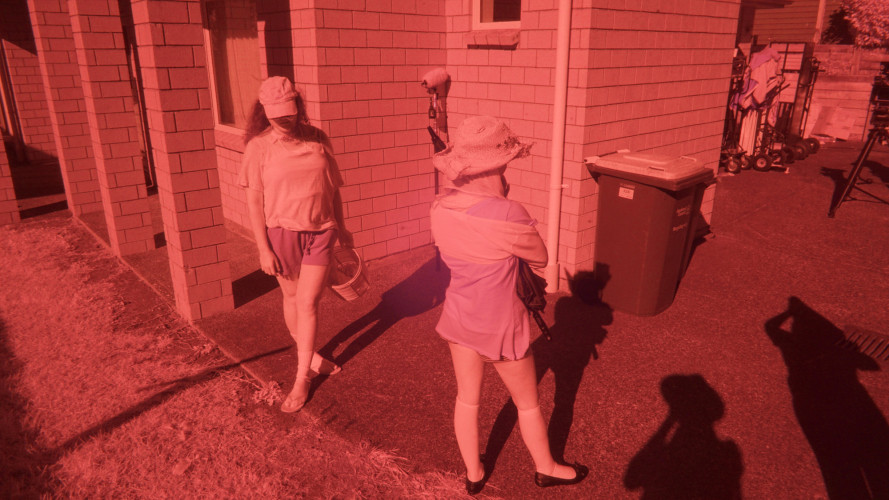
Juliet Carpenter On-set photograph 2026 (detail). Courtesy of the artist
Juliet Carpenter
Heaven's Blade
10 October 2026 - 21 February 2027
Heaven’s Blade unfolds in a speculative world where the sun has become too intense for people to spend extended periods outdoors. Juliet Carpenter’s new moving image work, shot across Central Otago and Hawke’s Bay, follows two young girls in a multi-generational household as they navigate their relationship to light, visibility and the consequences of exposure. The film’s observational approach traces the repetition and rituals of domestic life, letting unease surface gradually through what stays unseen and unspoken—the hostile conditions beyond the walls of the home, and the family matriarch confined to a darkened room within.
Carpenter’s practice explores how images, perception, and subjectivity are constructed and mediated through film technologies—here, through black-and-white photography, infrared imaging, surveillance systems, and spatial design. The film also draws on the tradition of settler-colonial landscape painting in Aotearoa New Zealand and on what art historian Francis Pound called the “Regional Real”: the way in which the idea of a specific and intense quality of “New Zealand light” made its way into the canon of twentieth-century landscape painting. In Heaven’s Blade, Carpenter explores these ideas through the raw material of filmic image making itself: light.
Heaven’s Blade is presented as two unique exhibitions premiering concurrently at Dunedin Public Art Gallery and Te Whare Toi o Heretaunga Hastings Art Gallery over the summer of 2026-27. In Ōtepoti Dunedin, the exhibition space is divided between exterior and interior worlds. The exposed structure of the screen and the internal cinematic installation mirror the tension separating the outside world from the enclosed domestic spaces of the film. A live feed video from the Hastings exhibition depicts a reconstruction of a 1970s painting from the Dunedin Public Art Gallery collection, further looping and refracting the two parallel presentations. The work traces cycles of representation in which images are continually reproduced and transformed, creating subjects while simultaneously violating them. Between Ōtepoti Dunedin and Heretaunga Hastings, Heaven’s Blade builds an immersive and unsettling cinematic environment where ecological, historical, and psychological forces converge.
Juliet Carpenter (b. 1990, Waipukurau, Central Hawke’s Bay) is an artist and filmmaker from Aotearoa New Zealand, currently living and working in Germany. Carpenter holds a BFA from Elam School of Fine Arts, Auckland (2014) and graduated from the Staatliche Hochschule für Bildende Künste Städelschule, Frankfurt am Main in 2022. In 2024, Carpenter was nominated for the Walters Prize for her outstanding contribution to contemporary art in Aotearoa New Zealand.
________
Ka huraina a Heaven’s Blade e tētahi ao- whakapae, ki reira rangona ai ngā hihi o te rā, ā, he pērā rawa te wera ka kino ina puta te tangata ki waho mō te wā roa. Ko tā te kiriata hou a Juliet Carpenter, i hopukina ki Te Matau-a-Māui me Ōtākou, he whai i tētahi tokorua kōtiro e noho ana i tētahi kāinga reanga-maha me tā rāua whai i te māramatanga, te kitea, me ngā pānga o te huranga. He matāho te kiriata ki te toaitanga me ngā tikanga i te kāinga, ā, ka huraina ngā pīerenuku me uaua ka kitea, me uaua ka kōrerotia, pēnei i te huarere kei tua i ngā pakitara o te kāinga, me te kuia o te whānau e noho raungaiti ana ki tētahi rūma pōuriuri.
Ka tūhuratia e ngā mahi a Carpenter mahi te āhua o te whakaritenga me te pāhotanga o ngā whakaahua, o ngā whakaaro, me te taparoto i ngā hangarau kiriata. Heoi, i konei kitea ai he whakaahua kiwikiwi, he whakaahua pōkākā, he pūnaha tūtei, he hoahoa mokowā anō hoki. He whakaahua te kiriata nō ngā tikanga peita taiao i Aotearoa, ka mutu, nō tā te hītōria, tā Francis Pound “The Regional Real”, te āhua o te whai wāhi o te muramuratanga o Aotearoa ki ngā tikanga peita taiao o te rautau rua tekau. I Heaven’s Blade ka tūhuratia ēnei whakaaro e Carpenter - ko te rawa e whakamuramura ana i a ia anō.
Whakaaturia ai a Heaven’s Blade e ngā whakaaturanga e rua. E tū ngātahi ana ki Te Whare Toi Tūmatanui o Ōtepoti me Te Whare Toi o Heretaunga i te raumati o te 2026-2027. I Ōtepoti, kua whakawehea te taiwhanga whakaaturanga ki ngā ao e rua. Ko te mata e huraina ana me te ata o te puninga toi te whakaata o te tanuku o te ao o waho me ngā wāhanga rāroto e kōpani ana o te kiriata. Nā te whāngai mataora i te whakaaturanga i Heretaunga e whakaatuhia nei te whakahoutanga o tētahi mahi peita nō te 1970, nō te kohinga o Te Whare Toi Tūmatanui o Ōtepoti, hei whakaū i te rongomaiwhiti o ngā whakaaturanga whakarara e rua. Ka tāwhaitia e tēnei puninga te hurihanga whakaata. He rite tonu te whakahounga me te panonitanga o ngā whakaahua kia hua mai ai he kaupapa, kia turakina anō ai he kaupapa. I Ōtepoti ki Heretaunga, e whakatūria ana e Heaven’s Blade tētahi taiao whakahihiri hinengaro, e hono ai te hauropi, te hītōri, me te hinengaro.
He ringa toi a Juliet Carpenter (i whānau mai i te 1990 ki Waipukurau) he kaihanga kiriata nō Aotearoa engari kei Tiamana ia e noho ana, e mahi ana anō hoki. I whakawhiwhia a Carpenter ki te Tohu Paetahi Toi i te Kura Toi o Elam, i Tāmaki Makaurau, i te 2014, ā, i puta tana ihu i Staatliche Hochschule für Bildende Künste Städelschule i Frankfurt am Main i te 2022. I te 2024, i whakangoatia a Carpenter ki te tohu o te Walters Prize hei whakanui i tōna tino koha ki ngā toi hou i Aotearoa.