DOSE
— take a moment for creativity
24 February 2026
When I was little and all wound up, my dad would tell me to “relax and go with the flow.” It was the ’70s. He had a big beard and a perm, and wore bell-bottom jeans and embroidered shirts I wish he still had.
Now it’s 2026, and I find myself crossing paths with the idea of “flow” again. But from a slightly different perspective.
The phrase creative flow entered our vernacular in the 1960s. It was coined by Hungarian-American psychologist Mihaly Csikszentmihalyi to describe that delicious state of mind we enter when we become so completely absorbed in an activity that everything else falls away. Time shifts. Self-consciousness softens. You are simply there. Immersed, engaged and fully alive in the moment. It’s almost as if you can press “pause” on everything else for a while and find a measure of peace.
It was this idea of flow and what it feels like to be completely immersed in creation, that I was reflecting on while walking back to the DPAG after sitting with a young woman while she received her weekly chemotherapy treatment at Dunedin Hospital.
Hospitals are not places I instinctively associate with creativity. I tend to experience them as clinical, procedural, often tense, sometimes frightening, and occasionally life-altering. My attention is pulled toward symptoms, side effects, and the steady rhythm of medical routines. I wilt under the lights.
So as I returned to the gallery, I found myself wondering: was there any room for Csikszentmihalyi’s flow on the chemo ward?
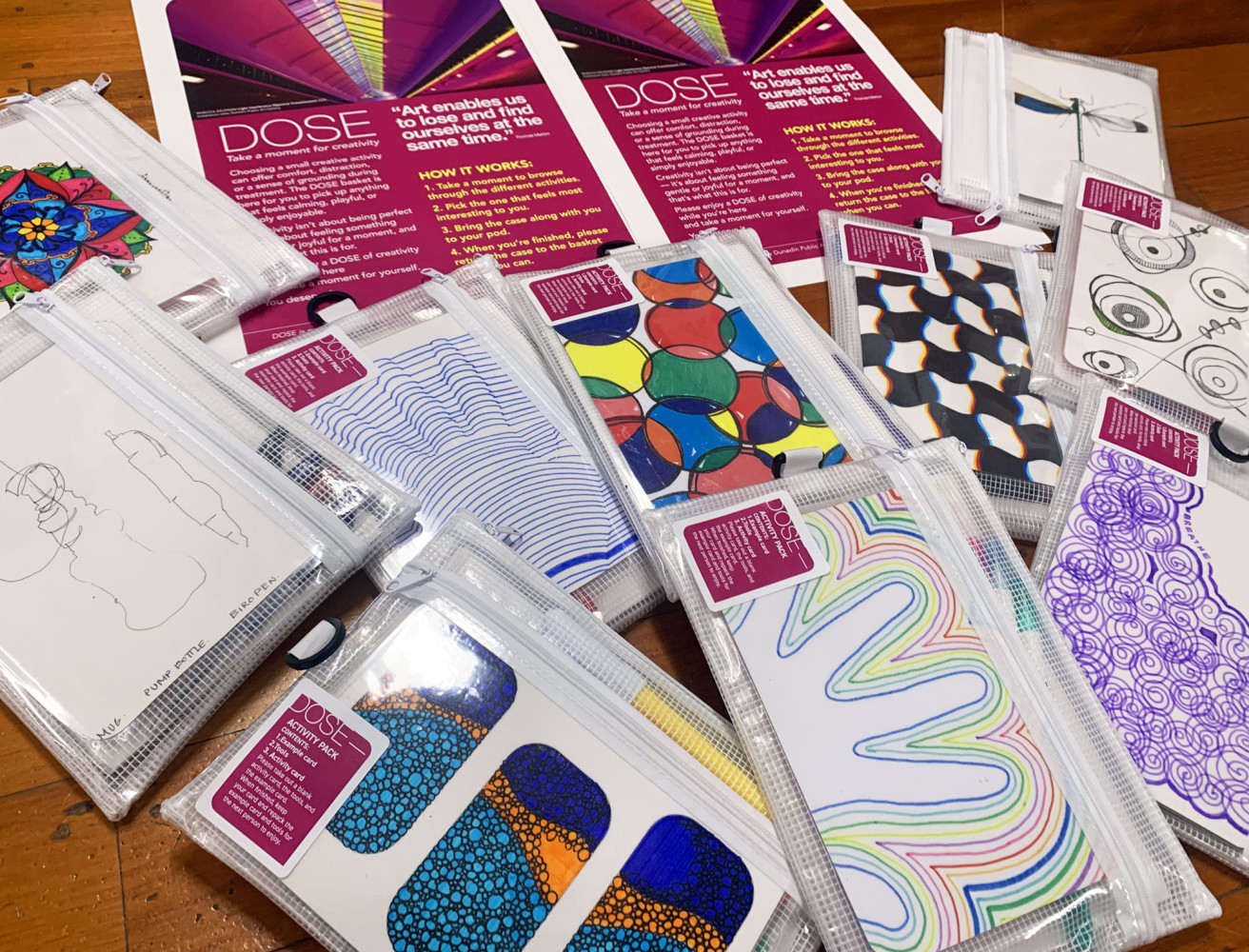
This question has led to DOSE — a set of mindful art activities developed by the Dunedin Public Art Gallery with support from the Dunedin Hospital and soon to be available for patients to use during chemotherapy treatment, if they choose. Each activity is designed to be portable, accessible and gently absorbing. They are invitations to create — structured just enough to offer guidance, yet open enough to allow for personal expression and exploration.
The aim is not to teach techniques or produce polished outcomes, but to offer entry into a space, however small, that can exist alongside clinical routines. A space that creates the conditions for flow, balancing challenge and ease so patients can experience focus, calm, and quiet engagement. An opportunity to turn attention toward the sensory experience of colour, the present moment of observation, the quiet concentration of making choices, and the rhythm of repeated mark making.
In a context where so much feels out of one’s control, creative absorption restores a small but powerful sense of agency: I am choosing this mark. I am shaping this image. I am here.
And sometimes, being able to press pause — to shift from patient to creator and slow your breath — matters deeply.
We acknowledge the staff at Dunedin Hospital who support patients in countless seen and unseen ways, sustain patients through treatment each day and whose steady presence make space for initiatives like this to take root.
Noho ora mai
Jen Boland
Community Curator
Dunedin Public Art Gallery